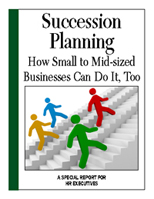
Excerpted from the Executive Report: Succession Planning: How Small to Mid-sized Businesses Can Do It, Too
Succession planning had always been something big companies did to prepare for when the CEO left.
Not any more.
Due mostly to a mobile and rapidly changing workforce, companies of all sizes are realizing the importance of mapping out a plan for the eventual replacement of key managers and key employees at all levels.
What can a good succession plan accomplish?
- It’ll strengthen your talent pool. The process of identifying high (and low) performers and possible gaps in your employees’ skillsets gives companies an opportunity to make adjustments before they’re left in the lurch when a key team member departs.
- You’ll make better use of the talent you’ve got. By definition, succession planning includes an employee development component. That means companies can allow workers to stretch their skills, increase their earning power and likely strengthen their commitment to sticking around.
- No fat to tide you over
Why has succession planning become so essential?
Years ago, many companies had an extra layer of fat at the managerial level, so bosses had more time to train and coach. Employees planned on sticking around – perhaps their entire careers.
There was a greater familiarity between the rank-and-file and management, and the work being done. Managers observed employees grow and develop over the years. When positions opened, they were more familiar with which employees were ready to step in.
Today is an era of job hopping, staff consolidation and downsizing. Organizations are lean.
It’s a lot tougher for managers to give individuals much-needed personal coaching – first, they have a lot less time, and second, you never know if people will stick around long enough to make it worthwhile.
Since most compensation structures are now based on production, a lot of supervisors see themselves more and more as project managers and less and less as people managers.
The end result: Not all managers really know what their employees might be capable of achieving, they only know what they’re capable of doing right now.
Matching people and potential
The key to a valuable succession plan is to create a match between future needs and the potential of employees to fill roles to assure the organization can meet those needs.
Retention is a major factor in succession planning because a proven way to hang on to the best and brightest is to give them opportunities for growth and greater responsibilities.
So what’s the ROI on a successful succession planning program?
- Companies have a group of stable, well-trained, experienced and reliable employees who are capable of stepping into key positions
- Employees have a clear blueprint for their future success with the organization, and
- Everyone – from the bottom up – is onboard and working toward achieving the goals and objectives of the company.
 DIGGING DEEPER
Succession planning isn’t just for upper management anymore. Good companies recognize the need for an ongoing strategy for maintaining a quality workforce throughout all organizational levels. This benefits organizations strengthening their talent pool and making better use of the talent they’ve got. Read the Executive Report: Succession Planning: How Small to Mid-sized Businesses Can Do It, Too

Speak Your Mind