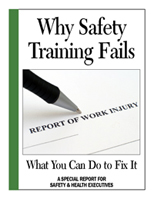
Excerpted from the Executive Report: Why Safety Training Fails: What You Can Do to Fix It
There are many reasons safety training fails to achieve its goals. Here are a few of them:
• It’s not learner-friendly.
• The way safety training is delivered runs counter to modern principles of adult learning.
• Ineffective delivery of safety training lectures.
• There is an over-emphasis on delivering information rather than on the specific needs of the learners.
• There is an over-reliance on written tests, which some workers do very poorly on, and
• Trainers expect automatic learning outcomes just because attendees sat through a session.
Adult learning is different
The process of adult learning is very different from the classic student learning at the elementary, high school and even university levels. Failure to recognize this crucial difference is one of the main reasons that safety training often fails, even the mandatory training that all safety professionals diligently dole out in their own workplaces.
Adults need to learn hands-on, by actually doing things. They resist being pulled back into a classroom and given texts to read.
Many safety professionals think that OSHA requires them to sit people down in a classroom and go over all the details of the agency’s sometimes arcane rules. Actually, OSHA doesn’t require that at all – all it cares about is that the training is effective and that employees do their jobs safely as they’ve been trained to do.
Lack of a training needs-assessment
One of the main reasons safety training often fails is that the trainer didn’t do a needs-assessment in advance with the workers scheduled to take the training.
Trainers often follow their own agenda blindly, rather than tailoring the training sessions to the needs of their workers. A survey should be conducted among the workers to ask them what they want to learn and what they want to get out of the training.
Or, if you know you don’t get much out of such surveys, you can simply observe the workers doing the job for a while and come to some conclusions on the finer points where they still need a little help to seamlessly follow all safety procedures as if it were second nature.
‘It’s too boring …’
When workers are interviewed on what works for them and what doesn’t in safety training, consistently their No. 1 complaint is that the trainer was just reading the slides from some canned presentation. The slides are probably not meant to be read. They’re supposed to etch a few key concepts and catchphrases into the trainees’ minds, but trainers should make some kind of effort to make the slides come to life with narration. To make it memorable, it’s all about story-telling.
The next biggest complaint from safety trainees is an over-reliance on reading materials by the trainer. Adult learners don’t want to sit and read long texts. Their eyes glaze over after a couple of paragraphs, if they can read the material at all.
They want to learn by doing, by hands-on demonstrations.
Show flexibility in training
The best way to make training stick is to make it as interactive as possible. You want maximum participation.
One of the worst things you can do is announce to the training class at the beginning that they must hold all questions until the end because you have a lot of material to cover. That kind of statement is guaranteed to kill all interactivity.
People who might have asked questions in the middle of the presentation to make sure they understood a particular step will have long forgotten what they wanted to ask when you get to the end – or they simply won’t bother anymore, having been beaten into dull submission by your droning on to cover all required material.
Safety trainers would do well to show some flexibility with any set curriculum. If the students want to go in a particular new direction with the material because that’s what interests them and that’s what’s important to them, let them – and then follow them into that area. It’ll be memorable to them, and they’ll be safer for it.
 DIGGING DEEPER
Safety training is key to any successful safety program. Yet, much of the safety training that is being done today isn’t as successful as it could be. Employees still make mistakes even after receiving the required safety training and many workers just don’t seem to retain enough of what was taught in the training courses. Read the Executive Report: Why Safety Training Fails: What You Can Do to Fix It

Speak Your Mind